Showing posts with label Cleveland Heights Historical Society. Show all posts

Tuesday, March 28, 2017

The Flick (2017)

"The Flick" at Dobama Theatre
Once upon a time, movie houses dotted the Cleveland Heights landscape like Dollar Stores do now.

My own children lament the loss of the Regal Cinema up at Severance. Sure, we can go to the Regal at Richmond for first-run movies or to Shaker Square, but they loved the idea of having a movie theater one block from our house.

Center Mayfield (1981)
Photo: Cleveland Heights Historical Society
I can remember the previous movie theater at Severance Center, which closed in 2000. When I was in college and just getting my east side footing, my new friends invited me across town to see Robocop, Dragnet … I must have been there a half dozen times during the summer of 1987 alone.

Never really liked the Regal at Severance and I don't like the one at Richmond ... mall movie theaters just make me unhappy. Like so many other hyper-business-structures, they redirected traffic from independent 35mm houses into their shiny multiplex madness, and now they too have fallen into disrepair, squalor and sadness.

The Center Mayfield was located not far from Severance, just up the street, a 1,200 seat house which was split and rather poorly, too, into three smaller theaters. The last time I saw a movie there was in early 1995, one of a few people in the house to watch Kenneth Branagh’s execrable Mary Shelley’s Frankenstein.

See, they’d cut up the theaters, but they hadn’t relocated the seats. In the middle theater, that may have been fine. But if you were in the left-hand theater (as I was) your seat would be angled slightly toward the right wall of the theater, you had to twist your spine a little to view the screen straight on. At that time I was awaiting a hernia operation and I do not remember ever being so uncomfortable in my life. And I was watching Mary Shelley’s Frankenstein.

Center Mayfield (2016)
Photo: Cinema Treasures
Not long after that experience, the Center Mayfield closed their doors. The following twenty-two years it languished, first as a Hollywood Video, then as a liquor store. A movie rental store with an actual marquee is not bad. A liquor store in a former movie house that couldn’t bother to remove the trappings of having more recently been a Hollywood Video, that was pathetic. January 2017, the entire building was bulldozed, and is currently a large, flooded pit.

The theater seats, however, had an afterlife. They were acquired by Dobama, and during the summer of 1995 were cleaned and installed in their former venue on Coventry until that company was evicted ten years later, in 2005.

A few years earlier, in 1992, business partners Charles Zuchowski and Morrie Zryl renovated the former Heights Art Theatre at the corner of Euclid Heights Boulevard and Coventry. Originally built in 1919, this movie house was best known for featuring pornographic films in the 1970s and 80s.

Centrum Theatre (1998)
Photo: cleveland.com
Rebranded the Centrum Theatre, I first saw a great many films from the 1990s there (Romeo + Juliet, When We Were Kings) as well as significant revivals. I had that rare opportunity few people have to first see Citizen Kane on a big screen, and also Orson Welles’s storied Othello.

Before we were married, my wife and I both worked at 1846 Coventry, in very the same building. I was down in the basement working as public relations director for Dobama (until 1998) and she was an editor for the Free Times up on the second floor. After work, we could walk around the corner to see a movie, just like that.

However, Zuchowski and Zryl sold the place shortly after the renovation, and the national distributor which had bought it sunk slowly into debt, giving up before the decade was out. The poster for the last film I saw there, Being John Malkovich, remained on display for the better part of 2000. Another company tried to revive the house but with little success. The Centrum has its final screening in 2003.

Meanwhile, Dobama Theatre had found a new home in the former YMCA space, now part of an expanded complex for the Cleveland Heights-University Heights Public Library. But they needed theater seats!

Guess where the theater seats came from? That’s right.

Annie Baker’s play The Flick follows the theme of disappointment in contemporary America set by her previous works like Circle Mirror Transformation and The Aliens. The story takes place in a rundown, independent movie house (in my mind I imagine the last days of the Center Mayfield) and the characters are an unlikely trio who manage and maintain the theater - we never see the owner - and set in the theater itself.

I am a great admirer of Baker's writing and was very excited when I first learned that Dobama would be producing The Flick. This new work created some controversy when it debuted at Playwrights Horizons in 2013. Some complained to the artistic director that the play is too long.

Seats go into the new Dobama Theatre on Lee Road (2009)
Photo: cleveland.com
That wasn’t the controversy, though, audience members will complain about anything. No, the controversy was when the artistic director sent a letter apologizing to their subscribers for not having warned them of the play’s length, which is bullshit.

Anyway, The Flick went on to win Baker the Pulitzer Prize, and you know what they say is the best revenge.

Dobama is where I have seen both Circle Mirror and Aliens, and each time I was first uninspired by the premise (evening theater classes, slackers slacking behind a convenience store) only to be compelled and moved by the characters, their stories, the plot, the performances. Last Thursday I had the opportunity to catch The Flick before it closed, which was a blessing.

One of the most interesting features of this play is where it is set. As I said, it takes place in the theater itself, not the lobby or at the concession stand, but in the house. Wherever this play has been produced the audience is first subjected to the somewhat disorienting picture of something which is at once completely familiar, but also not.

Detail.
You are looking at the back of a movie theater, facing the seats, the door you would have normally entered through to see the movie, you can see into the projection booth and what’s inside of it.

You are the screen. The absent movie going audience is facing you.

In the Dobama space, you may or may not notice that the seats on the set are identical to those you are sitting in. Not just the red fabric of the seats themselves, but the sides of the seats at the end of each row, are blazoned with interlocking “Zs.”

Two Zs, for Zuchowski and Zryl, seats custom-made for the late Centrum Theatre.

The Flick by Annie Baker was produced at Dobama Theater, March 3 - 26, 2017.

Sunday, May 22, 2011

Chef Boyardee

Cleveland Press Collection
Cleveland State University Archives.  

My investigation into the 1950s seems to involve a lot of cheap food products.

Ettore "Hector" Boiardi (October 22, 1897 – June 21, 1985) was born in Piacenza, Italy and passed through Ellis Island when he was 16 years old. By the time he was 20 years-old he was the head chef of the Ritz Carlton Hotel in New York City.

Really? That's what it says. Amazing, there's your American success story for you, right there. His abilities attracted the attentions of the owners of the Windham Hotel, who lured him to Cleveland. He must have been some kind of business entrepreneur because in 1924, before he was even close to 30, Boiardi has opened his own restaurant, Il Giardino d'Italia (The Garden of Italy) at the corner of East 9th and Woodland. He lived at that time at 2501 Arlington Road in Cleveland Heights.

Now, the foods we traditionally think of as "Italian" in this country are based on the simple, inexpensive meals prepared by the poor immigrants who were looking for a new way of life. Italian cuisine was and is diverse and interesting - in Italy. But in the United States in those days it meant pasta and sauce. Experiencing the relative cheapness of the basic ingredients only made the portions larger, not more adventurous.

As the Depression stretched on, spaghetti and the entire Italian food craze was in full swing, and Il Giardino was a hit. Citizens clamored to take home Boiardi's sauce, which he was happy to sell to them, originally in milk bottles with a bag of dry noodles and Parmesan cheese to go with. He soon built a factory to keep up with demand.


"Hello, may I come in?"
Chef Boyardee TV commercial, 1953

You make it look so good.
World War II was where the Chef really hit the big-time, creating easy-to-prepare canned spaghetti for the Allies. By this time, his well-known canned pasta products were selling under the name "Boy-Ar-Dee" in a successful attempt to get everyone to pronounce his name correctly.

Like so much else that gave "our boys" comfort during the war, demand continued when they returned to the States.

DID YOU KNOW ..? Self-adhesive stamps were designed to provide to soldiers during the 1991 Persian Gulf War because gummed stamps were useless to carry around in the deserts of the Middle East -- and that their domestic introduction was due to, you guessed it, demand from Iraq War vets? True story.

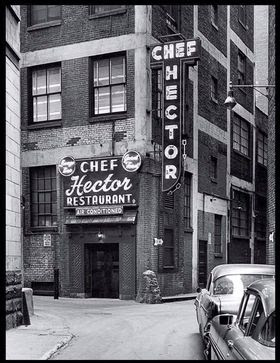
Though operations moved to Pennsylvania during the 1930s, he remained a dedicated Cleveland restaurateur, opening Chef Boiardi's in 1931, and becoming a part-owner in several other local establishments.

Chef Boyardee died in Parma. And haven't we all, at least once?

Sources:
Wikipedia
Cool History of Cleveland
Encyclopedia of Cleveland History
Cleveland Heights Historical Society

Friday, November 5, 2010

Oxford Elementary Murals

My daughter just started her first session of indoor soccer, which is led at one of the local elementary schools - but not hers. The last time I visited Oxford Elementary School was to hand out information before an election ... Jesus, was that in 2004? Never been inside.

So we're walking from the gym (where they held scrimmage) to one of the classrooms (where they would be conducting strategy, complete with an animated smartboard - classy!) and pass this wide, brightly painted mural.

"Wait," I said to the parent walking with me, "did that say W.P.A.?" I doubled back and sure as hell, there it was ...


"Federal Art Project
W.P.A. In Ohio"

Finding info on it online was not hard, and led me to a website I was previously ignorant of, a website for the Cleveland Heights Historical Society and an article about the numerous Federal Art Project murals and ceramics to be found at Oxford Elementary, an article written by Mazie Adams, the parent of one of my kid's schoolmates.

Oxford Elementary applied for and received funding for the creation of "two hydrocals (a type of extra-hard plaster) and thirty-five ceramics." In early 1937 the murals were painted directly to the walls by artist Gladys Carambella, the one I saw and that is featured above is of The Pied Piper of Hamlin.

In the 1970s as certain Heights schools were being torn down or renovated, the other mural, depicting the tale of Cinderella was almost destroyed. A little research revealed the forgotten origin of the works - and how federally-funded art is actually protected by the Federal Government. A layer of glue was applied to "save" the artwork, which made the formerly brightly colored work look much worse, and yellowed over the next quarter century. A grant from the Cleveland Foundation led to their proper restoration in 2000.

Source:
"National Art Treasures in Cleveland Heights" (Mazie Adams)
Cleveland Heights Historical Society